Anritsu Innovation — Engineering the Next Decade of Measurement

Our R&D team is pioneering software-defined instruments, AI-enhanced diagnostics, and extended-frequency platforms that anticipate the needs of 5G-Advanced, 6G, and beyond.

R&D at a Glance

14%
Revenue Invested in R&D
110+
Active Patents
85
R&D Engineers
6
Standards Body Memberships

Technology Focus Areas

Four research pillars driving our product roadmap and shaping the future of test and measurement.

Software-Defined Architecture

Reconfigurable measurement platforms where new protocol decoders, frequency band support, and analysis algorithms are delivered as firmware updates. This extends instrument lifespans by 3-5 years beyond traditional hardware-defined models, reducing total cost of ownership and electronic waste.

AI-Enhanced Measurement Intelligence

On-device machine learning models trained on millions of real-world signal captures. Automatic anomaly detection, interference classification (LTE-U, radar, IoT, co-channel), and root-cause recommendation — turning raw spectrum data into actionable insights without requiring expert interpretation.

Extended Frequency Frontiers

Pushing measurement capability from DC to 110 GHz and beyond. Our mmWave platforms support 5G NR FR2 beam verification, D-band (110-170 GHz) early research, and sub-THz channel sounding for 6G propagation studies. Custom MMIC front-end designs achieve industry-leading sensitivity at these frequencies.

Cloud-Connected Instrument Ecosystem

Secure cloud platform enabling remote instrument management, automated measurement scheduling, centralized data aggregation, and team-based collaboration. Engineers can monitor fleet-wide calibration status, share measurement templates, and trigger automated test sequences from any browser.

110+ Patents and Growing

Our intellectual property portfolio reflects deep investment in measurement science fundamentals.

  • Software-defined instrument reconfiguration methods
  • ML-based RF interference classification algorithms
  • Compact mmWave front-end receiver architectures
  • High-dynamic-range PIM measurement techniques
  • Automated fiber characterization sequencing
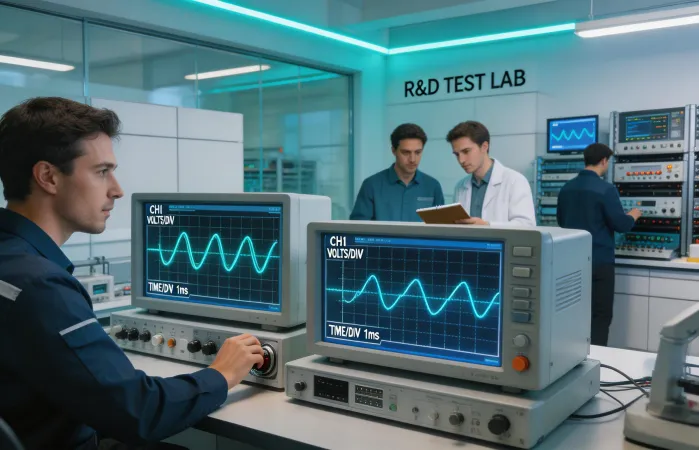
Anritsu R&D team at work

Technical Trade-offs in Test & Measurement

Selecting the right measurement approach involves balancing competing priorities. We present both sides so engineers can make informed decisions.

5G mmWave vs. Sub-6 GHz Testing Priority

mmWave deployments (24-40 GHz, up to 800 MHz channel bandwidth) deliver massive throughput for dense venues and industrial IoT with sub-1 ms latency. However, mmWave signals attenuate rapidly — path loss at 28 GHz is approximately 20 dB greater than at 3.5 GHz over the same distance, requiring dense small-cell infrastructure.

Sub-6 GHz bands (3.3-4.2 GHz in most markets) offer superior building penetration and coverage radius, reducing infrastructure density requirements by 5-10x compared to mmWave. For nationwide rollout economics, sub-6 GHz remains more cost-effective, though bandwidth per channel is limited to 100 MHz.

Selection factor: Choose mmWave test capability if your deployment targets stadiums, factories, or campus environments. Prioritize sub-6 GHz if coverage footprint and cost-per-square-km drive your network planning.

Single-Vendor Stack vs. Open/Disaggregated Networking

Integrated single-vendor stacks (Cisco, Nokia, Ericsson) deliver a unified management plane, single-point-of-contact support, and pre-validated interoperability. Deployment timelines are typically 30-40% shorter for greenfield builds.

Open and disaggregated architectures (OpenConfig, SONiC, O-RAN) avoid vendor lock-in and enable best-of-breed component selection. White-box switches can reduce hardware costs by 40-60%, but require deeper in-house engineering expertise for integration, testing, and lifecycle management.

Testing implication: Disaggregated networks require more extensive interoperability and conformance testing at each integration point, increasing demand for protocol-aware analyzers and automated regression test frameworks.

Measurement Capabilities & Boundaries

Transparent disclosure of instrument performance boundaries helps engineers select the right tool and interpret results correctly.

Frequency Range Constraints

Handheld spectrum analyzers cover DC to 54 GHz in standard configuration. Measurements above 54 GHz require optional external mixer modules, which introduce additional insertion loss of 8-12 dB and reduce the effective displayed average noise level (DANL). Coverage to 110 GHz is available only on benchtop platforms.

Environmental Operating Limits

Field instruments are rated for -10°C to +55°C operating range per MIL-STD-810G Method 501.5/502.5. Performance specifications are guaranteed at 23°C ±5°C. At temperature extremes, amplitude accuracy degrades by up to ±0.5 dB and frequency reference stability may drift beyond ±1 ppm without GPS disciplining.

OTDR Dead Zone Considerations

Event dead zones of 0.8 m and attenuation dead zones of 3.5 m are typical for standard OTDR modules at 1550 nm. Short-haul fiber links under 500 m may require specialized short-range OTDR modules with reduced pulse widths to resolve closely-spaced events, adding cost to the instrument configuration.

Collaborate With Our R&D Team

We partner with universities, standards bodies, and industry leaders on joint research initiatives. Explore how we can advance measurement science together.

Discuss a Partnership